
Shielded LGV Routing: Classical Planning vs Reinforcement Learning for Warehouse Vehicles
I built a warehouse simulator where six laser-guided vehicles are routed by nine methods, classical planners and reinforcement learning, all under the same PIBT-inspired collision shield. Collisions stay at zero, so the methods compete on throughput alone. The classical planners won.
6
LGVs in simulation
9
Methods compared
0
Collisions (runtime-checked)
Yes
Live demo
Hypothesis
If one collision shield keeps every routing method safe, so that methods compete on throughput alone, do learned policies beat classical multi-agent planners?
- Problem
- A warehouse fleet has to deliver pallets quickly without two vehicles ever colliding. When a learned policy must learn safety and speed at the same time it tends to freeze, and comparisons between methods stop being fair.
- My role
- Solo course project (Advanced Statistical Learning and Modeling): simulator, shield, nine methods, evaluation and live demo.
- Result
- Classical planners won: prioritized planning reached 3.03× greedy throughput against 2.53× for the best learned policy, a bootstrapped DQN, with zero collisions in every evaluated run. A hybrid that learns only the planning order reached 3.00×.
Honest limits
- Results come from one simulated warehouse layout (15 held-out task streams), not a real fleet.
- Walking workers exist only in the live demo; they were never part of the evaluation.
- The planners are deterministic, so they have 15 runs each against 75 for each learned method; a stratified bootstrap widens the DQN interval to 2.33 to 2.66.
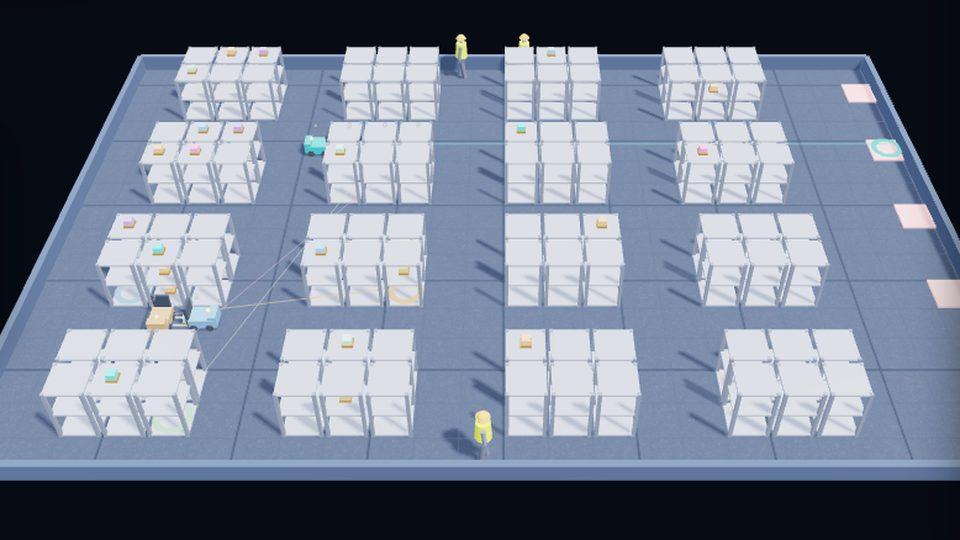
Runs right here on this page. It loads from Hugging Face, which may set its own cookies, and a sleeping demo takes 30 to 60 seconds to wake up.
One PIBT-inspired shield under every method
Six LGVs share the warehouse aisles (walking workers appear in the live demo only, not in the scored runs). Every routing method, classical or learned, runs on top of the same collision shield: a priority-ordered simplification of PIBT (without its priority inheritance or backtracking) that checks every joint move. A separate conflict check asserts zero collisions at every simulation step.
Because safety lives in the shield and not in the planner, the comparison reduces to throughput. Evaluated over 5 seeds on 15 held-out task streams on one warehouse layout, with IQM and bootstrap confidence intervals, the classical planners won: prioritized planning 3.03x greedy throughput and CBS 3.01x, against 2.53x for the best learned policy.
What every learned method has to beat
Greedy
Each LGV picks the shortest route to its current goal ignoring others. Fast baseline; breaks down under congestion.
Prioritized planning
Plans LGVs one at a time in priority order, each respecting the previously planned trajectories. Practical, used in industry; can fail when priority order is wrong.
Conflict-Based Search (CBS)
Two-level optimal search: a constraint tree at the top, single-agent A* at each leaf. Optimal in its textbook form; here windowed with an expansion cap for the lifelong task stream.
How the learned methods compared
Hybrid (learned priority)
Prioritized planning where a small network, trained with REINFORCE as a ranking, picks the order in which vehicles are planned. 3.00x greedy throughput.
Bootstrapped DQN
Randomized-prior bootstrapped DQN ensemble (K=8) with Thompson sampling per episode and a warm start from expert demonstrations. 2.53x greedy, the best end-to-end learned policy.
PPO, MAPPO, A2C, BC
Parameter-shared PPO 1.56x, behaviour cloning 1.40x, MAPPO with a centralised critic 1.29x, and A2C 1.10x (its interval includes 1.0, so not clearly above greedy).
Workers walk; the fleet adapts without retraining
Workers walk warehouse aisles on the same grid the LGVs use. Every routing method navigates around them without retraining, because the shield treats workers as dynamic obstacles, the same way it treats other vehicles. In the live demo only; workers were not part of the evaluation.
Switch methods, reshape the warehouse, add workers
Python simulation server, WebSocket streaming, live web client. Pick any of six methods (greedy, prioritized, CBS, behaviour cloning, bootstrapped DQN, hybrid), change the warehouse layout, raise or lower the number of human workers. The shield runs underneath all of it.
Loads LGV Warehouse Live Demo from huggingface.co, which may set its own cookies. A sleeping demo takes 30 to 60 seconds to wake up.
Frameworks and infrastructure
Solo project for the Advanced Statistical Learning and Modeling course at Federico II. Demo source on the HuggingFace Space files tab.